Monday, December 30, 2013

NEW YEAR PLEDGE

NEW YEAR PLEDGE

Feasts, visitors at the door and symbols of increasing fortune, it's time to bring in the New Year with thought. Adding good luck rituals may bring more prosperity, love and fun to this coming year.


One very easy practice is to show an empty purse to the moon and ask her to fill it. This can also be done with a cleared out box of any size. Using meditation, visualize a vacant lot and ask for a new home or hold an image of a barren parking garage and request a new car.


"Place a silver coin on the front porch before midnight. Then on New Year's Day retrieve the coin and throughout the entire year, know money is sure to arrive when it is desired."


Food is also thought to bring good luck. Black-eyed peas, cabbage and anything circular is believed to bring good luck. Cook favourite foods with special meaning and share this with everyone at the table.


Sunday, December 29, 2013

NEW YEAR - NEW MOON 2014

A NEW YEAR ~ A NEW MOON

2014

New beginnings, fresh starts, optimism, hope and faith


January 1st features a New Moon in Capricorn. New Moons are often a good time to plan out what you’re doing and what you want to achieve for the next month, and Capricorn has a reputation for being solid and dependable.

One of the main features of this New Moon is a square between The Sun, Moon, Mercury and Pluto in conjunction with Capricorn to the Mars in Libra-Uranus in Aries opposition. 

In astronomy, new moon is the first phase of the Moon, when it lies closest to the Sun in the sky as seen from the Earth. More precisely, it is the instant when the Moon and the Sun have the same ecliptical longitude.  The Moon is not normally visible at this time except when it is seen in silhouette during a solar eclipse.

The original meaning of the phrase new moon, was the first visible crescent of the Moon, after conjunction with the Sun.  The astronomical new moon, sometimes known as the dark moon to avoid confusion, occurs by definition at the moment of conjunction in ecliptical longitude with the Sun, when the Moon is invisible from the Earth. This moment is unique and does not depend on location, and in certain circumstances it coincides with a solar eclipse.

The New Moon phase is best used for personal growth, healing and blessing of new projects or ventures. It's also a good time to cleanse and consecrate new tools and objects you wish to use during rituals, ceremonies or an up coming festival.

The new Moon is waxing and growing. This marks the phase of the moon when the light is not visible from Earth, because the side of the moon that is being lit by the sun is not facing us. This should be a time to plan spells that introduce new beginnings and projects.  A new career, house move, job, relationship, any new venture in life.


Magic is a comprehensive knowledge of all nature

Saturday, December 28, 2013

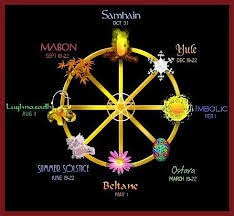
Wheel of the Year - Southern Hemisphere

Despite what appears to be a wealth of information available on neo-Pagan traditions, one section of the community seems to be grossly under-represented and that is those of us who reside in the Southern Hemisphere – South Africa, Australia and New Zealand, to name but three countries. The majority of authors residing in the Northern Hemisphere seem to have little knowledge of the differences between the hemispheres. And if such a difference is acknowledged, it is usually limited to only the Sabbats. It is no wonder that endless debates occur on how to "do things" south of the equator.

There are at least four major differences between the Hemispheres. The first is the obvious six-month difference in the seasons. When it is Midsummer in the Northern Hemisphere, we in the South are celebrating Midwinter. The dates, in general, of the Southern Sabbats are:
Samhain – 1 May
Midwinter Solstice (Yule) – 20 - 23 June
Imbolc - 1 August
Spring or Vernal Equinox (Ostara) – 20 - 23 September
Beltane – 31 October
Midsummer Solstice (Litha) – 20 - 23 December
Lammas  - 2 February
Autumn Equinox (Mabon) – 20 - 23 March
If we use the astrological signs in which the Sun moves into to determine each Sabbat date as opposed to actual calendar dates, then this too is changed by six months:


Samhain - 15⁰ Taurus
Midwinter Solstice - 0⁰ Cancer
Imbolc - 15⁰ Leo
Spring Equinox - 0⁰ Libra
Beltane - 15⁰ Scorpio
Midsummer Solstice - 0⁰ Capricorn
Lammas - 15⁰ Aquarius
Autumn Equinox - 0⁰ Aries

This means that Northern Hemisphere-based festivals appear largely out of place in the Southern Hemisphere. However, there are specific events that do align - in particular specific Southern Hemisphere-based public holidays.

The next major difference between the Hemispheres is the direction in which the Sun moves across the sky. As in the Northern Hemisphere, the Sun still rises in the East and sets in the West, however on its journey across the sky in the Southern Hemisphere, it travels via the North because of the tilt of the Earth's axis. For this reason, most Pagans in the Southern Hemisphere cast their circles in this direction, via the North or in an anti-clockwise direction.

A further observance is that the energy flow of the Earth between the Northern and Southern Hemispheres is also reversed. Prior to spending time in England I was told to observe the direction in which the water drained down the plughole. In the Northern Hemisphere, energy moves in a clockwise direction, whereas in the Southern Hemisphere, it is anti-clockwise.

If we take the above information into consideration when placing the elements around our magickal circle, it then seems logical for the placement of Fire to be in the North, while Earth is placed in the South.

A number of traditional Crafters who continue to place their altars in the North because according to their tradition (despite it being Northern Hemispheric-based) this is the "dark quarter." One reasoning behind this is that on the astral the directional placements of the elements do not matter. If this is the case, then when I operate between the worlds, it should not matter if my physical altar and circle casting reflects the land in which I reside. Surely, if the founders of Earth-based traditions such as the Craft and Wicca (for example, Gerald Gardner, Alex Sanders or even Aleister Crowley) were based, or had spent some time, in the Southern Hemisphere, would they not have taken the differences into consideration?

Another difference between the hemispheres, which is often overlooked, is the direction in which the crescents of the Waxing and Waning Moons point. In the Southern Hemisphere, the Waxing Moon in the sky actually points to the right, while the Waning Moon points to the left. Therefore the symbol of the Triple Moon Goddess (the maiden, mother and crone) reflects an introverted appearance opposed to the extroverted appearance in the Northern Hemisphere. But there are times where the Moon decides to really throw the spanner into the works and the Waxing Moon can be observed lying on her back pointing upwards, and the corresponding Waning Moon pointing downwards.

For us Southern Pagan practitioners, there is more to take into consideration when we work our magick and our circles than simply swapping the Sabbat dates around. And with the varying opinions and reasons behind even basic circle casting, it is little wonder newcomers to the various Pagan traditions in the Southern Hemisphere find it all very confusing.


Friday, December 27, 2013

WICCA COVEN


In Wicca and other similar forms of modern neopagan witchcraft, such as Stregheria and Feri Witchcraft, a coven is a gathering or community of witches. 
It is composed of a group of believers who gather together for ceremonies of worship such as Drawing Down the Moon,
or celebrating the Sabbats. The number of persons involved may vary. Although thirteen is considered ideal, any group of at least three can be a coven. 
 
A group of two is usually called a "working couple" (regardless of their sexes). Within the community, many believe that a coven larger than thirteen is unwieldy, citing unwieldy group dynamics and an unfair burden on the leadership.  When a coven has grown too large to be manageable, it may split, or "hive". In Wicca this may also occur when a newly made High Priest or High Priestess, also called 3rd Degree ordination, leaves to start their own coven.
 Wiccan covens are generally jointly led by a High Priestess and a High Priest, though some are led by only one or the other. In more recent forms of neopagan witchcraft, covens are sometimes run as democracies with a rotating leadership.

Thursday, January 3, 2013

HISTORY OF WIND CHIMES


A Brief History of Wind Chimes

Wind chimes have a long and varied history.  As one of the world's first musical instruments, wind chimes have long been known for their soothing, meditative and sometimes earthly sounds.  As a result of their unique sound, wind chimes have served as a way of shaping the ambience of natural settings.


The wind chime can trace back almost 5000 years.  The first evidence of wind chimes, found at archaeological sites in South East Asia, dates them to about 3000 B.C.  Primitive constructions of bone, wood or bamboo, stone or shells, the earliest wind chimes were used to ward off evil spirits.  By 2000 B.C. the wind chime had been developed independently along the shores of the Mediterranean and was being cast in bronze by the ancient Egyptians.

It wasn't until around 1100 B.C., when the Chinese started casting bells, that the wind chime found its more modern, musical and artistic evolution.  Highly skilled metal workers created the forefather of the wind chime, a clapper-less bell called yong-zhong, which was used as an accompaniment for religious ceremonies.  After that the Chinese developed what is essentially the modern wind bell, called the feng-ling.  This they hung from the eaves of shrines, temples, pagodas and in caves as wind bells are considered religious talismans, to repel evil demons and ghosts and attract benevolent spirits.  This practise was adopted in the secular world and wind chimes became common adornments in the home as a way to protect against spiteful supernatural influences.


The use of wind chimes in the home spread from China to Japan and from there to the western world in the 1800's when Asian art, design and philosophy started to show a distinct influence in Europe and America.  The practise of feng-shui helped to spread the knowledge of a wind chimes calming and balancing influence in the home.  An ancient system of using arrangement maximize the flow of life energy, or Chi, feng-shui often uses wind chimes as a means of shaping an environment and influencing chi.  The tones and materials of a particular wind chime can affect energy and change the mood and feeling of a living space. 


From uses in pagodas to ward off evil spirits to their employ by ancient Celtic tribes as a means of tricking their enemies into thinking the woods were haunted, the wind chime has had long and diverse role throughout history.  In its modern incarnation the wind chime is a wonderful accent to any home or garden.  The soothing tones echo the music of the breeze and bring a relaxed, meditative feeling to an environment; creating a place of peace and balance.

Wednesday, January 2, 2013

CLEANSING GEMS AND CRYSTALS


Cleansing Gems and Crystals of Negative Energies

Gems and crystals come from the earth.  They are alive. They are mined by hand or machine, and are removed from the earth to be used for many different purposes.

When gems, crystals, or rocks of any type are in the earth, they are exposed to earth energies including magnetic energy fields and electric energy fields. 
For example, when lightening strikes the earth, it sends enormous amounts of energy into the earth, and the gems, crystals and rocks within it.  Molten lava pouring out of an active volcano, the heat and minerals within it and how it affects the energy within its range of influence.
All planets, including the Sun, the Moon, Venus, Mars, Jupiter, Uranus, Pluto, Saturn, and all other planets, stars, and energies in the Universe influence the energy of gems and crystals.

It’s important to remember that gems and crystals are alive.  To remain alive and energized once removed from the Earth, gems, crystals, and objects made from elements taken from the earth, need to be cleansed and energized on a regular basis.


Gems and Crystals Attract and Absorb Energy:

Your gems and crystals basically anything around you, or on you, can attract positive and negative energy and hold that energy unless the object is cleansed. 

Suggested Methods for Cleansing Crystals and Gems:
The following are methods for cleansing crystals and gems. These methods can also be used to cleanse other objects.  I try to keep my gems and crystals exposed to the sun and moon on an ongoing basis.

The Sun and Moon:  Place your gems & crystals in a place where they will be fully exposed to the energizing rays of the sun and moon.  Even if the day is cloudy or you cannot see the moon, their rays will energize the stones as long as they are directly exposed to these elements of nature.  They will normally be cleansed within 24 hours of exposure.

However, stones such as black tourmaline which are being used to deflect negative energies or help release negative energies in your physical and energetic bodies, may require up to 48 hours to become fully cleansed and regenerated.

Stones such as aquamarine and amethyst will fade in the sun so you will have to use another method for cleansing and regenerating these gemstones.

The Earth:  Place your gems and crystals in the earth, either directly into the earth or you can place the gems and crystals into a cloth, preferably a natural fabric such as cotton or wool or silk.  Leave the gem or crystal buried for at least 24 hours to ensure that they become fully re-energized.  If possible, find a spot where the soil is not being spread with chemicals through fertilizers or pesticides.  This cleanses all negative energies and re-energizes the stones.

Smudging With White Sage:  Take some white sage and begin to burn it until a good strong smoke is coming from your sage.  Hold the crystal or gem, in this smoke for at least one minute.  This clears all negative energies that have become attached to this stone but does not energize the gem or crystal.  To re-energize the stone, place it in a window so it can be exposed to the rays of the sun and moon.  Remember, they re-energize even when it’s cloudy.


Running Water: If you live where you have access to good clear well water that is guaranteed to be free of chemicals, or running water from a creek or river that you know is not polluted, place your crystals and gems in a small container, and let the water run over them, for at least two hours.  This will cleanse and re-energize your gems and crystals.  Please do not use tap water, since it is full of chemicals.  Be careful though because certain stones will actually dissolve in water, e.g. Red Selenite.

Whatever methods you choose, treat your gems and crystals with tender and loving kindness.  These stones can do so much to heal at all levels including the physical, emotional, intellectual and spiritual levels.  They are magical gifts from the Universe and we need to treat them with respect and gratitude.  If you no longer want to keep a crystal or gem, take it outside and bury it so it may return to Mother Earth, from whence it came.

Tuesday, December 18, 2012

SUMMER SOLSTICE SOUTHERN HEMISPHERE


December Summer Solstice 2012
Southern Hemisphere


21 Dec 2012     11:12 (UTC)

Local Times for December Solstice worldwide

The December solstice is also known as the "summer solstice" in the southern hemisphere. It is the winter solstice only in the northern hemisphere.

The end of the world in 2012?
Many prophecies about the end of the world surround this date because it corresponds to the last day of the Mayan calendar.

What happens at the solstice?

The North Pole is tilted furthest away from the sun at the solstice.   The December solstice occurs when the sun reaches its most southerly declination of -23.5 degrees. In other words, it is when the North Pole is tilted 23.5 degrees away from the sun. Depending on the Gregorian calendar, the December solstice occurs annually on a day between December 20 and December 23. On this date, all places above a latitude of 66.5 degrees north (Arctic Polar Circle) are now in darkness, while locations below a latitude of 66.5 degrees south (Antarctic Polar Circle) receive 24 hours of daylight.

The sun is directly overhead on the Tropic of Capricorn in the southern hemisphere during the December solstice. It also marks the longest day of the year in terms of daylight hours for those living south of the equator. Those living or travelling south from the Antarctic Circle towards the South Pole will see the midnight sun during this time of the year.

On the contrary, for an observer in the northern hemisphere, the December solstice marks the day of the year with the least hours of daylight. Those living or travelling north of the Arctic Circle towards the North Pole will not be able to see the sun during this time of the year.


The December solstice in the calendar
December 20 and December 23 solstices occur less frequently than December 21 or December 22 solstices in the Gregorian calendar. The last December 23 solstice occurred in 1903 and will not occur again until the year 2303. A December 20 solstice has occurred very rarely, with the next one occurring in the year 2080.

Seasons, Equinoxes and Solstices

Seasons Calculator – When seasons start
March Equinox Explained
–traditions around March Equinox
June Solstice Explained
–traditions around June Solstice
September Equinox Explained
–traditions around September Equinox
December Solstice Explained
–traditions around December Solstice
Equinox day is not exactly 12 hours long
As with the June solstice, the December solstice’s varying dates are mainly due to the calendar system. The Gregorian calendar, which is used in most western countries, has 365 days in a common year and 366 days in a leap year. However, the tropical year, which is the length of time the sun takes to return to the same position in the seasons cycle (as seen from Earth), is different to the calendar year. The tropical year is approximately 365.242199 days but varies from year to year because of the influence of other planets. The exact orbital and daily rotational motion of the Earth, such as the “wobble” in the Earth's axis (precession), also contributes to the changing solstice dates.


Over the course of history, many different schemes have been devised to determine the start of the year. Some are astronomical, beginning at the September or March equinox, or at the June or December solstice. Solstices are more readily observable either by observing when the midday shadow of a gnomon is longest (winter solstice in the northern hemisphere) or shortest (summer solstice in the northern hemisphere). The solstices can also be observed by noting the point of time when the sun rises or sets as far south as it does during the course of the year (winter in the northern hemisphere) or maximally north (summer in the northern hemisphere).

All dates refer to Coordinated Universal Time (UTC). Dates may vary depending on the time zone.

December solstice in relation to seasons

It is important to note that Earth does not move at a constant speed in its elliptical orbit. Therefore the seasons are not of equal length: the times taken for the sun to move from the vernal equinox to the summer solstice, to the autumnal equinox, to the winter solstice, and back to the vernal equinox are roughly 92.8, 93.6, 89.8 and 89.0 days respectively. The consolation in the northern hemisphere is that spring and summer last longer than autumn and winter (when the December solstice occurs).

The relative position of the Earth's axis to the sun changes during the cycle of seasons. This phenomenon is the reason why the sun’s height above the horizon changes throughout the year. It is also responsible for the seasons through controlling the intensity and duration of sunlight received at various locations around the planet.


Solstice’s influence on cultures
The December solstice has played an important role the lives of many people in ancient times. To this day, the world is still influenced by various traditions linked to the observance of the December solstice.

The Summer Solstice

Focus: Power, joy and courage, male potency, success, marriage, fertility of all kinds, especially for older women and for anyone approaching middle age; for happiness, strength, energy, self-confidence, identity, health, wealth and career; also for maximising opportunities, seizing chances and enjoying the present.

Keywords: Power, leadership, authority

Element: Fire


Direction: South

Energies: The high turning point as full power begins to wane from this day

Symbols: Brightly-coloured flowers, oak boughs or tall broad indigenous trees, golden fern pollen that is said to reveal buried treasure wherever it falls, scarlet, orange and yellow ribbons, gold coloured coins and any gold jewellery that can be empowered at the festival, any golden fruit or vegetables.

Animal: Bear

Tree: Oak


Incenses, flower and herbs: Chamomile, dill, elder, fennel, lavender, frankincense, orange, marigolds, rosemary, sage and sagebrush, St. John’s Wort, lemon verbena and vervain, any golden, red or orange flowers

Candle colours: Red, orange, gold


Crystals: Amber, carnelian or red jasper, sun stone; also sparkling crystal quartz spheres


Celtic Tradition:

Litha means light and Alban Heruin the light of the shore as the sun floods over the land ripening the crops. But it is bittersweet for the Sun God and Goddess who want the day to last forever. Because she loved him, bonfires were lit and sun wheels made of flaming cart wheels were rolled down the hillsides to prolong the light on this longest of days.

The Goddess, or her representative, cast her bouquet of summer flowers on a hilltop fire to add her power to the sun.

The cauldron was the symbol of the goddess giving forth her bounty on the Solstice and may be filled with small golden coloured fruits and crystals as coven gifts.

The height of the festival has always been first light falling on Solstice morn, like a shaft of gold across standing stones and stone circles, linking the dimensions.

Stonehenge is oriented to mark the sunrise and moonrise at the Summer and Winter solstices, built long before the time of the Celts.

Druidic ceremonies based, it is believed on Celtic ones, are held at Dawn and Noon on the Summer Solstice at sacred circles such as Stonehenge and some groups and individuals still keep vigil from sunset on the previous evening.

At sunset of the Summer Solstice at Stonehenge, another significant ritual point the Heel (Sun) Stone outside the circles casts a shadow on the Altar Stone, thus marking the beginning of the dying of the year.

Ritual activity:

This works as well whether you are celebrating the festival alone or with others and is based on an old Scandinavian folk custom.

At dawn set a basket of seven different species of flowers or seven different colours where they will catch the first light of the Summer Solstice.

 At noon each person should weave the seven kinds of flowers on to a small circle of wire, using threads in red, yellow, green and blue to attach them

As you/they weave silently name for each flower over and over again in your mind or a whisper your/ their dearest secret wish for fulfilment in the next twelve months whether for lasting love, a child, the success of a creative venture, happiness, travel, success , health or spiritual wisdom.

When finished the circlet/s should be hung on a shady tree and you/the group should circle the tree nine times deosil or sun wise, nine times in the opposite direction and then nine times deosil, clapping rhythm till the world spins, chanting’ Come to me as I dance the Midsummer Tree, come to me in my sleep, come to me in my waking, that when I next dance the Midsummer tree, I shall know the joy of the seven flowers sweet.’

If you are working alone you can adapt the chant to fit your desire, for example if for lasting love, ‘that when next I dance the Midsummer tree, it shall be my wedding day.’

At sundown take your wreath from the tree and hang it over your bed. Go straight to bed when it is dark/ Picture yourself walking as you drift into sleep  along a pathway of flowers into mist that slowly clears to reveal how and when you will attain your desire. This may continue in your dreams

Leave the wreath on the wall of your bedroom till it fades and then release the petals to the wind or use the flowers in incense

Other activities
Make sun water by leaving out still mineral water in a bowl covered with film or mesh from dawn till noon (or for up to eight hours on a darker day). Add clear quartz or citrine crystals to the water when you put it out (the previous evening if you prefer) and remove these at noon.

Use the water as an energiser in baths and drinks in the days ahead and to splash on the centre of your hairline to open your Crown chakra and clear your aura when you feel tired or doubt yourself.

Light a gold candle and set any small gold items of jewellery round it if the day is dark or cloudy until the candle burns though. If it is a sunny Solstice leave the jewellery in the sunlight after dawn for a few hours to transfer the power of the sun into your life as you wear the jewellery in the days ahead.

Cast golden flowers or herbs into the air from a hill or open place, a handful at a time, making empowerments for courage and achievement to the winds and naming for each handful a plan to begin or bring to fruition starting tomorrow.

Light sun oils, frankincense, juniper, rosemary, orange or benzoin or burn them as incense to bring the sun power into your home or workplace as darkness finally falls. Vow not to let the joy of the day fade from your life and relight one of the oils or incenses whenever you do feel sad or anxious.